Introduction: A Changing Environment for Product Teams
It is 2025 and the world of product management has been transformed by generative AI and large language models (LLMs). These advances have rewired team workflows, business metrics and customer expectations across industries. Product managers (PMs)—once focused on intuition and incremental process improvements—now use predictive insights and adaptive technologies that shape every phase of digital product lifecycles. Adoption rates are staggering: 71% of enterprises regularly deploy generative AI in at least one business function and 67% use LLMs for everything from customer support to code generation. But what does this mean for PMs and how can teams realize the vast potential on offer? [1][2][3][11]
Let’s dive in to explore the stats, strategies, risks and evolving skills that define successful PMs in the age of generative AI.
Generative AI Adoption: More Than Just Hype
Generative AI is not just “smart automation” now; it is a fundamental force driving operational efficiency and competitive differentiation. By July 2024, 71% of global organizations used gen AI, up from just 33% the prior year. Spending on generative AI technologies is expected to reach $644 billion by 2025, with market growth forecasts exceeding 46% annually through the next five years (Source: Statista, McKinsey, 2025). Major names—Walmart, Apple, Netflix—have integrated AI-powered assistants and design systems at scale.[1][2]
Across retail, SaaS, finance and healthcare, AI adoption has pushed:
- Proposal development times down by 45%, helping sales teams close more deals.[4]
- Customer support ticket volumes reduced by 60% through LLM chatbots, with customer satisfaction scores up nearly 16%.[2][4]
- 88% of professionals reporting improved work quality after implementing LLMs.[3]

Generative AI uptake has exploded, making AI a core business driver in less than a decade
How LLMs Reshape Product Workflows and Value
LLMs are more than chatbots—they interpret data, draft proposals, code and even help PMs prioritize releases. The most advanced use cases in 2025 include embedding LLMs into knowledge bases, driving real-time recommendation engines and automating feedback analysis.
Consider the manufacturing sector: AI-driven predictive maintenance saves millions by avoiding equipment failure, while generative models optimize supply chain decisions and help maintain region-specific compliance. Similarly, in software teams, LLM-powered agents assist with user stories, prototype generation and backlog management, freeing PMs to focus on strategic alignment.[3][12]
Key Impacts:
- GenAI saves workers an average of 5.4% of their weekly hours—translating to a 1.1% overall productivity boost (Source: PwC, OECD, 2025).[13]
- Coders using generative AI tools are 88% more productive, while management consultants finish tasks 25% faster and of 40% higher quality (Source: Harvard, Github, 2025).[8]
But these benefits bring new risks: accuracy, bias, cybersecurity and ethical deployment. Many organizations now review all gen AI outputs before customer exposure, especially in sensitive industries like finance and healthcare.[1]
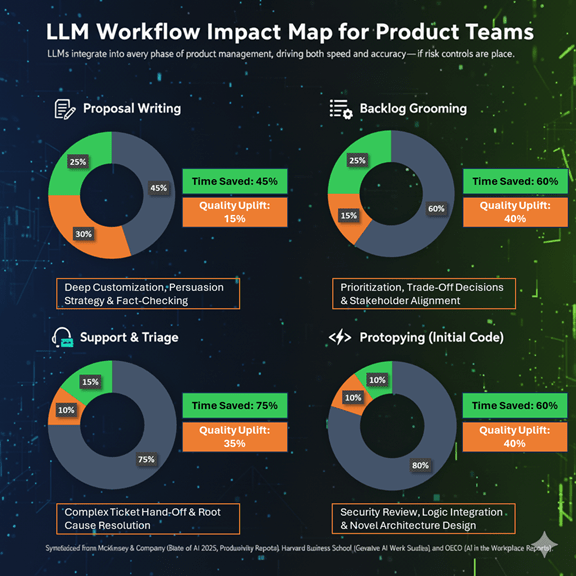
LLM Workflow Impact Map for Product Teams
Upskilling for the AI-Powered Product Manager
To thrive in this enviroment, PMs must embrace a blend of technical and strategic competencies. From AI & data literacy—knowing how models, training data and inference work—to product lifecycle management and agile development mastery, the modern PM is both a technologist and business leader.[6][7]
Top-demand skills:
- Foundational AI Knowledge: Understand supervised, unsupervised and reinforcement learning, neural networks and NLP concepts.
- Lifecycle Management: Know how AI products evolve, retrain and optimize post-launch—covering MLOps, ongoing feedback, continuous tuning.[7]
- Analytical decision-making: Use data pipelines and A/B testing to validate new features, spot trends and shape strategy.[6][14]
- Risk and ethics: Address data privacy, explainability, bias and compliance issues in every release.[1][7]
- User-centric design: Collaborate on solutions that center customer needs while leveraging AI to personalize and delight.[14][7]
As adoption accelerates, organizations face talent gaps: nearly half of AI PMs say hiring skilled data scientists and engineers is “very difficult,” especially at scale. PMs increasingly recieve training on AI governance, ethical deployment and real-time KPI tracking.[1]
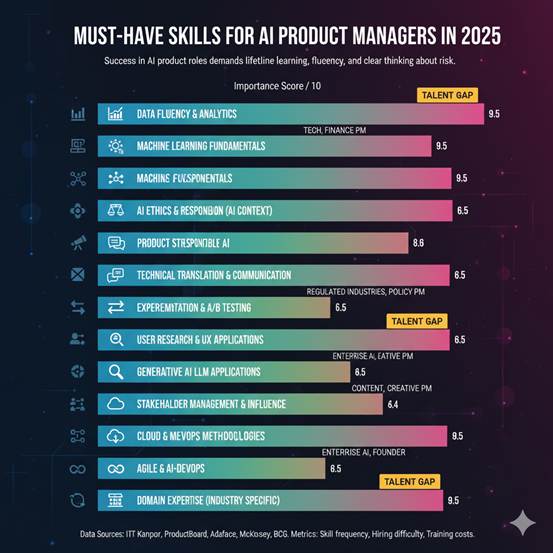
Must-Have Skills for AI Product Managers in 2025
Risks, Ethical Challenges and Organizational Transformation
While 92% of Fortune 500 companies now use generative AI, bottom-line impact remains elusive for many enterprises. Only 1% of surveyed execs describe their rollouts as “mature”—the rest are navigating skill shortages, centralization challenges and fast-evolving regulations. Key risks include:[1][2][15]
- Bias and hallucination: Generative models can generate misleading or biased outputs, requiring constant monitoring and guardrails.[1][8]
- Cybersecurity & data privacy: AI solutions often centralize sensitive data; ensuring compliance is both legal and ethical imperative.[1][7]
- Market and workflow redesign: To capture AI value, organizations must fundamentally change team structures, processes and training protocols. 21% of genAI adopters have already redesigned at least some workflows.[1]
Forward-thinking product teams now use hybrid deployment models, with both centralized AI centers of excellence and distributed team ownership. This enables agile responses to changing priorities and regulatory landscapes.
Conclusion: Embracing the Future — Thoughtfully
Generative AI and LLMs have changed the enviroment for product managers. Those who succeed will be lifelong learners, championing both technological fluency and ethical stewardship. The future is bright for PMs who act with clarity, embed AI where it matters and nurture human-centered innovation.
As adoption accelerates, so must our vigilance—about risk, talent and ongoing strategy. With every new model deployed, the PM’s role becomes more vital: guiding teams through change while keeping customers and stakeholders at the heart of every decision.
References
- “The State of AI: Global survey.” McKinsey, March 2025. https://www.mckinsey.com/capabilities/quantumblack/our-insights/the-state-of-ai
- “100+ Generative AI Statistics [August 2025].” Master of Code. https://masterofcode.com/blog/generative-ai-statistics
- “LLM statistics 2025: Adoption, trends and market insights.” Hostinger, June 2025. https://www.hostinger.com/tutorials/llm-statistics
- “Top 5 Groundbreaking LLM Use Cases in 2025.” RapidOps, Dec 2024. https://www.rapidops.com/blog/top-groundbreaking-llm-use-cases/
- “LLM Product Development in 2025: A Complete Guide.” Prioxis, Sept 2025. https://www.prioxis.com/blog/llm-product-development
- “AI Skills Product Managers Need to Adopt.” ProductBoard, July 2025. https://www.productboard.com/blog/ai-skills-product-managers-need/
- “Top 12 Skills Every AI Product Manager Should Master in 2025.” EICT Academy, July 2025. https://www.eicta.iitk.ac.in/knowledge-hub/product-management/ai-product-manager-skills
- “58 Generative AI Statistics for 2025.” Mend, Oct 2025. https://www.mend.io/blog/generative-ai-statistics-to-know-in-2025/
- “LLM Market Landscape 2025.” Powerdrill Bloom, Oct 2025. https://powerdrill.ai/blog/llm-market-landscape
- “Generative AI in 2025: Hype vs. Reality.” Akooda, April 2025. https://www.akooda.co/blog/state-of-generative-ai-adoption
- “Why AI Will Define Product Management in 2025—and How to Upskill Now” EICT Academy, July 2025. https://www.eicta.iitk.ac.in/knowledge-hub/product-management/why-ai-will-define-product-management
- “32 LLM Use Cases in 2025: Ultimate Guide”, ORQ, January 2025. https://orq.ai/blog/llm-use-cases
- “27 AI Productivity Statistics You Want to Know”, Apollo Technical, July 2025. https://www.apollotechnical.com/27-ai-productivity-statistics-you-want-to-know/
- “Skills required for AI Product Manager and how to assess them”, Adaface, May 2025. https://www.adaface.com/blog/skills-required-for-ai-product-manager/
“55+ New Generative AI Stats (2025)”, Exploding Topics, July 2025. https://explodingtopics.com/blog/generative-ai-stats




 Singh Spectrum
Leave a comment