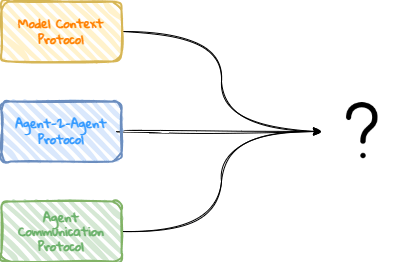
We are entering a new phase in the evolution of artificial intelligence, one where AI agents don’t just think, they talk.
Until now, most of us have interacted with AI as isolated tools: a chatbot here, a recommendation engine there. But behind the scenes a quiet revolution is taking place. AI is learning how to coordinate, collaborate and communicate, not just with humans but with each other.
This transformation is powered by emerging AI communication protocols — structured ways for AI systems to exchange information, delegate tasks and work together toward shared goals. You can think of these protocols like the rules of engagement in a bustling AI workplace. It is just like any company, which can function only if the employees know how to share notes, assign tasks or call for help. Without protocols collaboration would collapse into chaos.
In this article, we’ll explore some of the big questions ahead, like Will these protocols unify into one standard? Or will they be replaced altogether as the technology matures?
Whether you’re a technologist, a product leader or a business strategist, this article will help you make sense of the fast-evolving language of intelligent machines.
Tool vs. Agent?
Before we can begin to understand the path that the future might take, we need to look at the path it has presently taken. As AI evolves, we see a shift from simple AI tools to more autonomous agents, and this change has big implications for how AI systems communicate.
🛠️ AI Tools: An AI tool is built for a specific task. It takes an input, processes it, and gives you an output. Think of a chatbot that answers FAQs, a grammar checker or an image enhancer. These tools may use powerful AI under the hood, but they don’t act beyond the moment you use them. They don’t remember, adapt or make decisions unless you tell them to. Just like a vending machine — you push a button, get what you want, and that’s the end.
🔮 AI Agents: AI agents, on the other hand, are goal-oriented and autonomous. They don’t just wait for commands — they decide what steps to take, learn from outcomes and often initiate communication with other systems or agents to accomplish a task. For example, an AI agent managing your calendar might reschedule meetings based on traffic data, coordinate with another agent at your client’s office and notify you of changes, all without you having to ask. In other words, an AI agent is like a waiter — you explain what you want and they handle the rest, even checking with the kitchen or suggesting alternatives.
Why This Matters
The shift from tools to agents means AI systems now need to communicate, not just compute. That is why protocols like MCP, A2A and ACP are so important. They provide the shared rules that let intelligent agents talk, collaborate and solve problems together.
The Rise of AI Communication Protocols
These protocols aren’t about how smart the AI is, they are about how well it can coordinate. Here are three leading protocols shaping this space:
🎙️ MCP (Model Context Protocol) by Anthropic standardizes how large language models (LLMs) connect to various data sources and tools. Its like a consistent interface that allows models to access and integrate data from multiple sources — whether local files, databases, or APIs — without complex setup each time.
🎙️ A2A (Agent-to-Agent Protocol) by Google focuses on enabling agents from different frameworks to communicate and collaborate. Think of it as a bridge that allows agents using different technologies to share tasks and information, making it ideal for cross-platform collaboration.
🎙️ ACP (Agent Communication Protocol) from IBM enables communication and collaboration among multiple agents within the same environment. Its similar to a project management tool that allows agents — each with their own capabilities — to work together seamlessly in a shared space, making it ideal for multi-agent setups in localized systems.
These protocols are the foundation for building AI ecosystems where multiple intelligent systems can operate together — not as isolated tools, but as teammates.
Will These Protocols Converge or Compete?
As the AI ecosystem rapidly expands, a natural question arises: Will protocols like MCP, A2A, and ACP eventually merge into a single standard? Or will they evolve in parallel, each serving a different purpose or ecosystem?
To answer this, we need to look at both the technical intent behind each protocol and the market dynamics shaping them.
Different Origins, Different Strengths
Each of the three protocols has a unique origin story, rooted in the philosophy of its creators:
🎙️ MCP (Model Context Protocol) was created by Anthropic AI with the philosophy of standardizing and simplifying the integration of diverse data and tools into AI systems. The idea was inspired by the challenges of connecting AI models — specifically large language models (LLMs) — to various external resources, such as databases or APIs. Anthropic’s vision was to create a unified protocol that would act like a universal port, enabling LLMs to seamlessly access and process contextual data from different sources, making AI more efficient and adaptable in real-world applications.
🎙️ A2A (Agent-to-Agent Protocol) was born out of Google’s vision to create a seamless way for agents from different frameworks to work together. The idea stemmed from the growing complexity of AI ecosystems, where agents built on different platforms and languages often struggled to communicate. Google’s philosophy was rooted in collaboration and interoperability — they envisioned a future where AI agents could easily discover, communicate, and collaborate with each other, regardless of their origin. This led to the creation of A2A, a protocol designed to bridge gaps between various agent frameworks, enabling smooth, multi-agent workflows across diverse AI environments.
🎙️ ACP (Agent Communication Protocol) was developed by IBM Research in collaboration with BeeAI, driven by the philosophy of creating a unified system for managing and orchestrating multiple AI agents within a localized environment. The need arose from the low latency needs for agent interactions on the edge (e.g. bots in a manufacturing plant). ACP was conceived to enable smooth interactions between these agents within a single platform, allowing for faster and easier coordination, task delegation and multi-agent workflows, fostering a more collaborative and efficient AI environment.
So far, these protocols do not directly overlap, but they touch adjacent layers of the same stack — context-sharing (MCP), communication (A2A), and coordination (ACP).
Will They Merge Into One?
Not immediately.
While its tempting to imagine a future with a single, unified “AI language,” the truth is more complex. These protocols serve different functions, and trying to fuse them too early would be like combining email, Zoom and project management tools into one bloated app.
However, what we are likely to see is standardized bridges between them — adapters, middleware or interoperability layers that allow different types of agents to understand each other’s messages, even if they’re “speaking” different dialects. AI protocols might remain specialized, but still work together through agreed upon standards.
Will One Protocol “Win” and Replace the Rest?
Unlikely, at least not in the short term.
Just as we didn’t see one programming language dominate the software world, its unlikely that a single protocol will fit every use case. For example:
🛡️ A security-focused enterprise might favor ACP for its ability to orchestrate multiple agents within a controlled, local-first environment, ensuring better oversight and traceability.
🔬 A research lab working with diverse AI systems could choose A2A for its seamless agent-to-agent communication across different frameworks, enabling flexibility and collaboration in experiments.
🤖 A company focusing on AI-powered applications may adopt MCP to provide consistent, standardized access to external data and tools, enhancing the efficiency of large language models (LLMs).
In other words, the “best” protocol depends on the job to be done.
What Could Change the Game?
There are, however, a few things that could reshape the landscape:
- A dominant platform (like OpenAI or Google) might enforce a protocol standard by building widespread adoption into their tools and APIs.
- Open-source ecosystems could gravitate toward one protocol due to ease of use, community support or modularity.
- Regulatory frameworks might favor protocols that provide transparency, safety, or compliance features, giving ACP for instance, an edge in regulated industries.
So, What’s the Likely Future?
In the near term, we’re likely to see diversity, not unification but with growing emphasis on compatibility. Think of it like a “multi-lingual” AI world, where agents can communicate using translators, routers or shared standards.
In the long run, a new generation of protocols — possibly born from the lessons of MCP, A2A, and ACP — may emerge to provide a more holistic framework. These could unify context, communication and collaboration in a modular, layered system, much like how the internet standardized over time using TCP/IP, DNS and HTTP.
֍ MCP, A2A and ACP are not redundant — they solve different problems.
֍ They are more likely to coexist and interoperate than to merge or compete head-on.
֍ Future protocols may evolve from them, but the shift will be gradual, not abrupt.
֍ The real opportunity lies in building bridges, not bets — creating systems that can adapt to multiple protocols as needed.
Conclusion – What This Means for Business Leaders
The emergence of protocols like MCP, A2A and ACP marks a turning point in how AI systems are built and how they will interact with each other, and with us.
For business leaders the technical details may seem distant but the implications are real and immediate:
💡 From isolated tools to connected intelligence: As AI agents become more capable and autonomous, they will no longer work in silos. Businesses will deploy networks of agents that negotiate, delegate and collaborate with humans as well as each other. Understanding the role of communication protocols is key to enabling this shift.
💡 Strategic decisions will be protocol-aware: Whether you’re choosing an AI platform, designing workflows or ensuring compliance, knowing which protocols your agents use — and whether they can speak to others — will influence vendor choices, architecture and even partnerships.
💡 Standards will shape ecosystems: Just as mobile operating systems and cloud platforms created new rules of engagement, the rise of AI protocols will define the next layer of digital infrastructure. Organizations that adapt early and build around these emerging standards will be better positioned to innovate, scale, and stay secure.
In the early days of business computing, companies had standalone systems — a payroll tool here, a CRM tool there. Over time, integration became the goal, and APIs became the connective tissue. We are now at the same juncture with AI.
MCP, A2A, and ACP are not just acronyms — they are the beginning of a grammar for AI fluency. Those who learn to speak it early will shape the conversation tomorrow.
References
- “MCP, ACP, A2A, Oh my!” by Jack Proser, https://workos.com/blog/mcp-acp-a2a-oh-my
- “What Every AI Engineer Should Know About A2A, MCP & ACP” by Edwin Lisowski, https://medium.com/@elisowski/what-every-ai-engineer-should-know-about-a2a-mcp-acp-8335a210a742





 Singh Spectrum
Leave a comment