
In Part I of this two part article series we looked at the definition of Conflict and the various reasons why a conflict might occur in a workplace and the various participants and their roles in the conflict. If you have not already gone through Part I, I strongly suggest you do that, as this article heavily refers to Part I. In this article we are going to go over the methods of Conflict Resolution.
Conflict Resolution Approaches
There are 5 tried and tested approaches to Conflict Resolution:
- Confronting (the problem) – Approaching the conflict in a manner that attacks and eliminates the problem due to which the conflict exists – Win-Win
- Compromising – Accepting that the conflict is inevitable and coming to a mutual consensus on a way to deal with the conflict getting the best out of it for all the involved parties – Win-Win
- Smoothening – Sacrificing your stand in favor of the stand of the other party in order to eliminate the conflict (maybe in hopes of a later gain) – Lose-Win
- Forcing – Asserting your stand forcibly on the other party in order to eliminate the conflict by ordering/forcing the other party into agreement – Win-Lose
- Avoiding – Ignoring the existence of the conflict in the hopes that the problem will somehow go away or solve itself
In a given situation, any one of the above methods for conflict resolution can be employed. However, one way is always better than the rest depending on the dynamics of the situation. Therefore, before deciding on what to do, it is important to understand the deterministic factors for the approach to be employed.
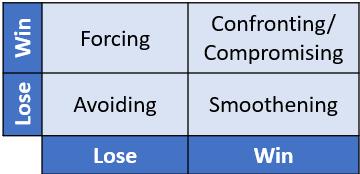
Factors determining the Approach to Conflict Resolution
- Can there be a Win-Win situation?
- How much time is available for conflict resolution?
- Is there trust between the two parties?
- How high are the stakes?
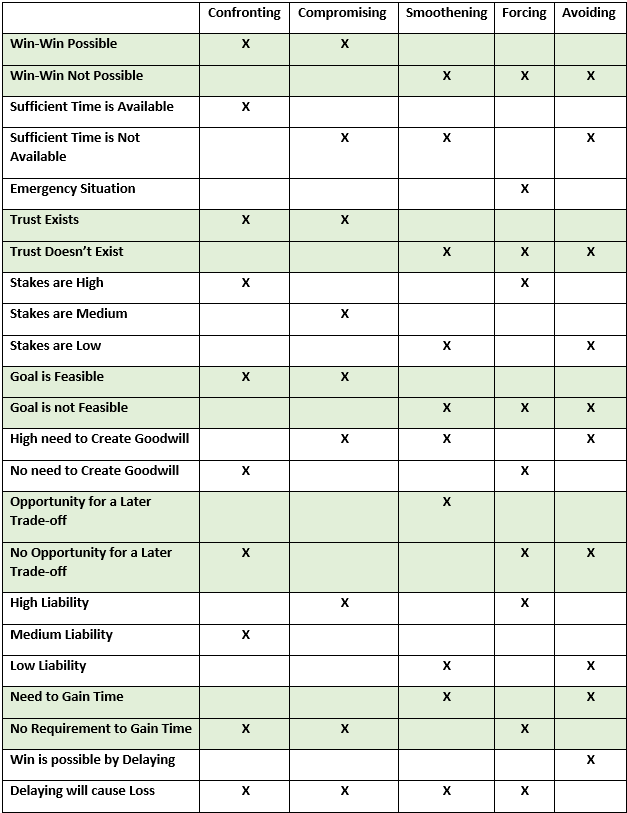
The below table provides the list of considerations and their relationship with the Conflict Resolution Mechanism to be chosen.
Conclusion
While there are various formal methods that provide a framework for conflict resolution, they are not a substitute for presence of mind and out-of-the-box thinking. Many conflicts can be resolved even before they begin, if the manager applies common sense and clear thinking to identify and resolve conflict festering situations and environments.







 Singh Spectrum
Leave a comment